Colombians added 100,914 residents in a year, Americans grew 15.7% and Britons fell 3.9%, and most of the change happens outside the expat bubble.
Spain granted Americans 11,470 first-time residence documents in 2025, 27.8% more than in 2024 (Ministry of Inclusion).
Benjamin, an American who came to Madrid by way of Puerto Rico, has been stopped in the street by older Spaniards, the mayores, while out with his blonde daughter. They fuss over her hair first. Then come the questions: how long have you been here, are you staying, and are you going to have more children? More than one of them has explained why they ask. Spain, they say, is getting too brown.
It's an honest remark, and a reflection of the times. The number of foreigners holding Spanish residence papers has grown by almost a third in five years (32.4%, if you like your numbers exact), and the mayores have noticed. The official numbers tell you who is arriving, but most of that story plays out in towns and barrios where expats rarely set foot.
The Ministry of Inclusion counts every foreigner holding a residence document, which is as close as Spain gets to an official expat count. On 30 June 2026, 7,909,008 foreign residents in Spain held one, 547,724 more than a year earlier (up 7.4%).
Then there's INE, Spain's national statistics office, which runs its own count and doesn't much care whether you have papers. If you live here, you're in. So for nearly every nationality in this article, Spain has two official answers to how many of them there are, and the two almost never match. Spanish bureaucracy at its finest: two arms of the same state, counting the same people, each arriving with complete confidence at a different number. Where it matters, we'll tell you whose number we're quoting.
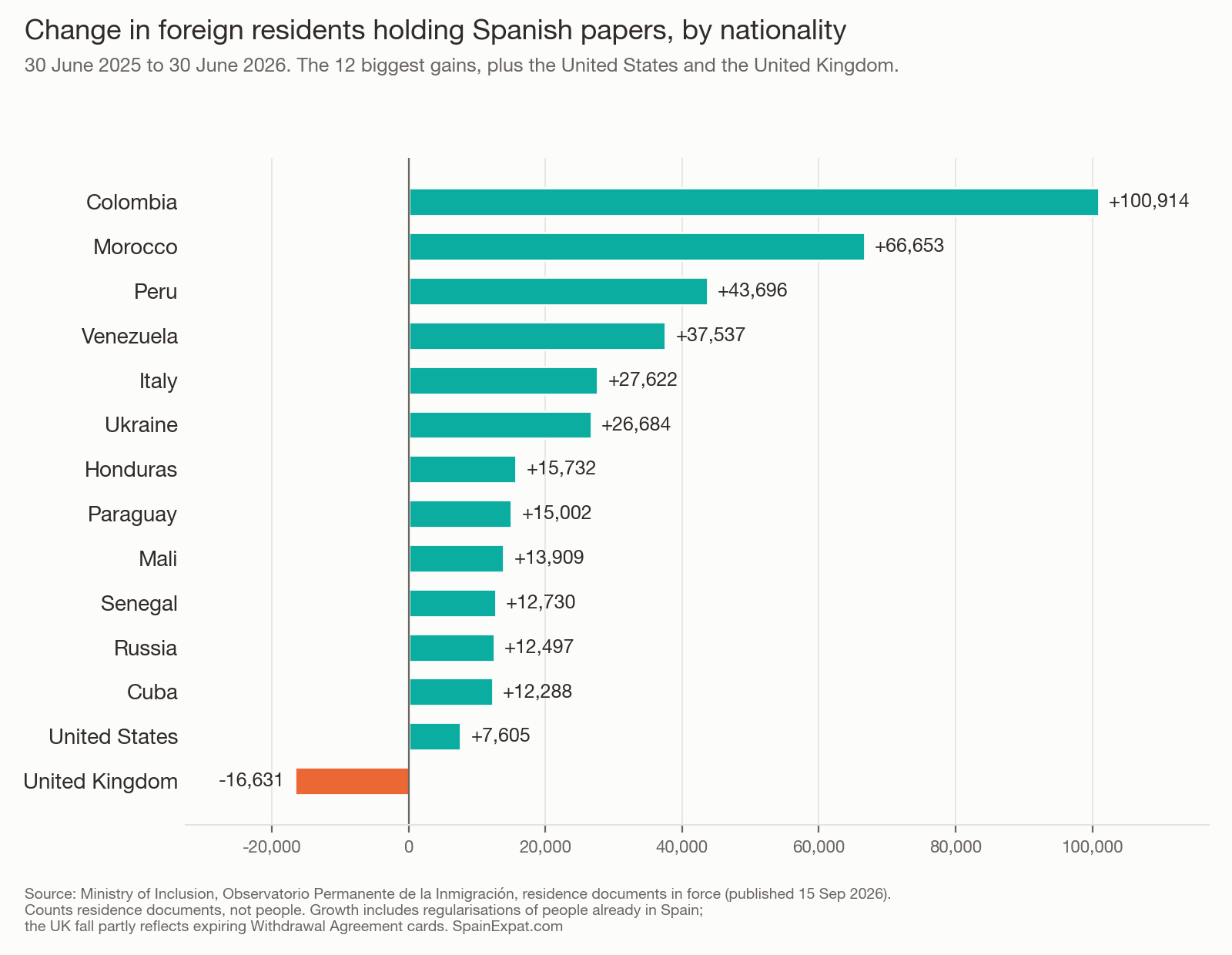
One bar on that chart towers over the rest. Colombians added 100,914 residence-document holders in the year to June 2026, taking them to 395,459 (up 34.3%), which is half as many again as Morocco's 66,653 in second place. Venezuelans, the other big Spanish-speaking group of recent years, added 37,537.
Most of that Colombian jump happened in Spain's filing cabinets rather than at Barajas, Madrid's airport. In January 2025, INE counted 676,534 Colombians living in Spain, and only 294,545 held a residence document that June. More than half of the year's increase (56,194) then came through arraigo, the permit for people who can show they've already been living here, while ordinary work permits fell by 12,430. Colombians also filed about 303,500 applications in this spring's extraordinary regularisation (a one-off chance for people living here without papers to apply for them), and almost none of those are in the figures yet, so expect another jump in December. Venezuelans, meanwhile, lost the humanitarian permit that carried most of them here, which Spain stopped granting in June.
Peru (+43,696), Honduras and Paraguay tell the same story on a smaller scale. The whole thing, including what's pushing people out of Colombia, has its own piece on why the Colombian numbers jumped.
EU citizens are a special case in Spain's books. They don't need a visa, they register once, and the registration certificate never expires. So a German who registered in Marbella in, say, 2009 and went home in 2012 is, as far as the ministry's tables are concerned, still sunning himself on the Costa del Sol. That makes EU totals look bigger than they are and EU growth look healthier than it is, since nobody who leaves is ever subtracted.
Germany's own statistics office makes the point nicely. It counted about 131,800 Germans living in Spain at the start of 2025, roughly 3,000 fewer than ten years earlier, and more than a quarter of them were 65 or older. Spain's ministry, meanwhile, has 222,236 German residence documents on file, up 22.1% in five years.
So take the EU citizens out. They added 91,408 residence documents in the year to June 2026 (and since nobody is ever subtracted, that's closer to new registrations than to net arrivals), which is about a sixth of the increase. Everyone else added 456,316, the other 83.3%, and Latin Americans alone account for nearly half of the total (48.5%). Strip Italy out of the chart above and the top ten is entirely non-EU (Colombia, Morocco, Peru, Venezuela, Ukraine, Honduras, Paraguay, Mali, Senegal and Russia).
Taking the EU out does take out some Latin Americans, because some of them arrive with a European passport. An Argentine with an Italian grandfather lands in Barcelona as an Italian. INE doesn't publish that figure country by country, but it does by region, and the group is smaller than you'd think. In January 2025, 208,790 people born in South America held the passport of another EU country (Italian, most likely, though INE doesn't say which), up about 18,000 in a year. Next to the 456,316 added by everyone from outside the EU, that's small change.
The group every passport count misses is much bigger. A Venezuelan with a Spanish mother lands as a Spaniard and never appears in a foreigner count at all, and neither does anybody who naturalises. INE counted 2.06 million Spanish nationals born in Latin America in January 2025, and across the whole country one in three people born abroad (32.8%) holds a Spanish passport.
So read the year two ways at once. By passport, it's the 456,316 extra documents held by people from outside the EU. By birthplace, the number of people living in Spain who were born abroad grew by 532,932 in the year to July 2026, to 10.29 million. INE's country-by-country birthplace figures are older (January 2025, with the next probably due in December), but they tell the same story, with Morocco first (1,165,955 people born there), Colombia second (978,041, up 14.2% in a year) and Venezuela third (692,316).
Where the two counts disagree, there's usually a story, and nowhere do they disagree more than over the Italians.
Italians are the third-biggest group in Spain, with 527,890 residence documents, and that number is up 45.2% in five years. Which is odd. Italy has a higher GDP per head than Spain (96 against 92 on the EU's purchasing-power index, where the EU average is 100), lower unemployment (6.3% against Spain's 10.3% in September 2026) and, depending on who you ask, better food.
Even the Italians can't agree on how many Italians live here. Italy's register of citizens abroad said 285,362 at the end of 2024, Spain's census said 345,777, and the ministry's documents say 527,890 (EU certificates never expire, remember). Whichever number you pick, it has been climbing fast.
The explanation is in the birth certificates. Two in three Italians living in Spain were born outside Italy (170,839 of 255,012 at the end of 2023, according to ISTAT, Italy's statistics office). A lot of them are Argentines and Venezuelans of Italian descent. They got the passport through an ancestor, then picked the EU country where they already speak the language. In 2024, half the Italians who moved to Spain from a third country came from Argentina (50.4%), and another 12.4% from Venezuela. So a fair slice of Spain's "EU" growth is probably Latin American migration travelling on an Italian passport.
Italy slammed much of that door in May 2025. Its Law 74/2025 treats people born abroad who hold another citizenship as never having been Italian, unless they'd applied by 27 March 2025 or have a parent or grandparent who held only Italian citizenship (there are a couple of other exceptions). Italy's Constitutional Court upheld the law in April 2026 and then asked the EU's Court of Justice to weigh in, and that case is still pending. Either way, the Argentine-Italian pipeline may slow.
Italian-born Italians are coming too, mind you. In 2025 Spain became the top destination for Italians leaving Italy, about 13,000 of them (and a third of those were born outside Italy as well). You can see why. Spain's economy grew 2.6% that year against Italy's 0.6%, Spain employs a bigger share of its adults (72.4% against 67.6%), and average full-time salaries are level (€33,700 against €33,523 in 2024). Il Sole 24 Ore and El Confidencial worked out in 2025 that for every Spaniard who moves to Italy, eight Italians move to Spain. Nobody tell Rome.
And then there are the Canaries. The two island provinces hold 82,013 Italians (15.5% of them), and in La Oliva, on Fuerteventura, nearly one resident in five is Italian (17.8%). We couldn't find anything published on why. If you're one of them, we'd love to hear it.
For all the Colombian fireworks, the two biggest communities in Spain are still Romanians (1,142,644 residence documents) and Moroccans (994,191), and it isn't close.
The Romanian number is inflated. Romania joined the EU in 2007, Romanians register once, and the certificate never expires, so everyone who registered and then went home is still on the books. INE's census, which counts people where they live, finds 609,270 Romanians against 968,999 Moroccans. On the ground the Moroccans are the bigger community, and the Romanian one is shrinking on every measure INE has. More Romanians have left Spain than arrived in each of the last three years with final figures (in 2024, 50,220 left and 38,104 came), and the number of people born in Romania fell 2.1% that year, to 521,181. The number of Romanian workers on the Social Security books has barely moved in nine years (327,124 in September 2017, 338,810 now), while the Moroccan number nearly doubled.
| Nationality | Holders, 30 June 2026 | 1 year | 5 years |
|---|---|---|---|
| Romania | 1,142,644 | +0.7% | +4.5% |
| Morocco | 994,191 | +7.2% | +18.9% |
| Italy | 527,890 | +5.5% | +45.2% |
| United Kingdom | 408,716 | -3.9% | +2.3% |
| Colombia | 395,459 | +34.3% | +172.2% |
| Ukraine | 352,785 | +8.2% | +267.9% |
| China | 271,869 | +3.5% | +18.3% |
| Venezuela | 261,924 | +16.7% | +66.8% |
| France | 233,142 | +4.8% | +28.5% |
| Germany | 222,236 | +4.3% | +22.1% |
They're also the two groups Spaniards seem to like least, though the evidence is thinner than you'd hope. The freshest hard data is about hostility rather than opinion. OBERAXE, the government's racism observatory, logged 2,870 hateful posts online in 2024, and North Africans were the target of 35% of them, more than any other group. In Catalonia, a 2025 survey by the regional government's polling centre (the CEO) asked people how someone close to them would feel if their son or daughter dated someone of a given origin. Almost 70% scored an East Asian, Black or Latin American partner positively, against under half for a Maghrebi or Arab one.
Nationally, immigration was Spaniards' second-biggest worry in the October 2026 survey by the CIS (Spain's state polling institute), named by 20.9% of people (housing came first by a mile, at 55.7%). Asked what affects them personally, though, only 11.2% named immigration, which puts it fifth.
The last national survey to ask about specific groups by name came from IESA-CSIC, a public research institute, in October 2020, which is six years and one invasion of Ukraine ago. It found 35% of Spaniards called Moroccans unlikeable, the highest of any group, and 26% said the same of "Eastern Europeans". Latin Americans scored 10% and drew the most sympathy, and most people answered "neither" for every group.
We'd bet the Eastern European number is lower now. Ukrainians drew more sympathy than almost anyone after the invasion (a CIS poll in March 2022 put them third of 11 nationalities, at 7.18 out of 10, behind only the Portuguese and the Italians). And Poland has nearly caught Spain. On Eurostat's measure of consumption per head it was 13 points behind in 2015 and only 4 behind in 2025, and the IMF has the two level on output per head this year, with Poland pulling ahead in 2027 on its projections. That makes "Eastern European" sound a lot less like a poor relation. Then again, when the pollster 40dB asked in September 2024, 9.6% of Spaniards still wouldn't let Eastern Europeans ("Bulgaria, Rumanía…", in the poll's own examples) come and live in Spain, against 3.9% for other Europeans and 8.8% for Latin Americans. So the goodwill may stop at Ukraine's border, and since no poll asks the same question before and after 2022, this one stays our opinion.
Spain's builders say they're short of hands. The national construction confederation, the CNC (the employers' side of the industry), talks of 700,000 workers needed in the coming years. That's an industry estimate about the future rather than a count of jobs sitting empty today. The one official measure of empty jobs, Eurostat's vacancy rate, was a modest 0.7% for construction at the end of 2025 (against 2.9% across the EU). The usual assumption is that Romanians and Moroccans fill the gap, and they do more than their share.
In INE's 2023 census (the best source there is for jobs by country of birth), 14.8% of Romanian-born workers and 13.7% of Moroccan-born workers were in construction, against 6.2% of Spanish-born workers. That makes them more than twice as likely to be on a building site. Ecuadorian-born workers (11.7%) aren't far behind. There just aren't enough of them to carry the industry. Together, Romanian- and Moroccan-born workers made up about 7% of the construction workforce (95,196 people), and three in four people working in construction were born in Spain.
Foreigners as a whole make up 27.9% of construction employees on the Social Security books (September 2026), so newcomers are very much in the trade. They just come from a lot more than two countries.
For Moroccans, the bigger story is the fields. They hold 104,818 registrations on the farm-work scheme (the Sistema Especial Agrario), 40% of all the foreigners on it. Around Almería's greenhouses (the sea of plastic you can see from space), whole towns are a quarter Moroccan or more (Níjar 30.8%, La Mojonera 25.3%). Romanians on the farm scheme number 34,203, about 13% of the foreigners on it.
We suspect some of the prejudice aimed at Romanians is meant for the Roma, and that the two get muddled in a lot of heads. (For the record, "Roma" and "Romania" aren't related words, whatever your uncle says.) Spain doesn't record ethnicity in its census (it isn't allowed to), so nobody knows how many Roma live here.
Spain's own gitano community (Spanish Roma) has been here for more than five centuries, and estimates put it somewhere between 725,000 and a million people, about 40% of them in Andalucía (those are projections from old studies, so treat them gently). Romanian and Bulgarian Roma are a separate and much more recent community. The last estimate of their number, from the Fundación Secretariado Gitano in 2012, was up to about 50,000, and nothing newer turned up in our search. Nationality says nothing about ethnicity, so none of these figures can tell you who is Roma (and anyone setting that 50,000 against the 1.14 million Romanian documents is doing bad maths).
SpainExpat Plus Ultra
Plus Ultra, SpainExpat's household membership, pays the professionals who handle registrations, school enrolment and home setup, with health insurance for every member from early 2027.
Ask for an invitation You'll see your price and terms before you pay anything.More than half of the Colombian increase in ordinary permits in the year to June 2026 (56,194) came through arraigo, the permit for people already living in Spain.
Most British and American expats could live here for years without getting to know many Romanians or Moroccans, and the census shows why. Britons make up 10% or more of the population in 76 municipalities. Those towns hold 23.6% of all the Britons in Spain, but only 1.8% of the Americans, 1.6% of the Moroccans and 0.8% of the Romanians.
The average Briton lives in a town that's 7.2% British. The average Romanian lives in a town that's 0.5% British, which is the national rate, so as far as Romanians are concerned the British might as well not exist. Britons cluster on the coast (San Fulgencio is 32.2% British, Rojales 29.4%, Mojácar 25.5%) and Americans in the big cities. Romanians live in Madrid's Henares corridor (Coslada 11.3%, Arganda del Rey 12.0%) and in agri-food towns like Guissona and La Almunia de Doña Godina, and Moroccans in Almería's greenhouse towns and in Murcia.
Statisticians have a measure for this, the dissimilarity index, which tells you what share of one group would have to move house to be spread out like another. On a scale where 100 means two groups never share a town, Britons and Romanians score 72.5. Colombians and Venezuelans, for comparison, score 25.7, which is about what you'd expect from two groups who share a language and a lot of the same barrios.
In most expat towns, what you see is more of yourselves moving in, plus a fair number of Russians (Torrevieja alone has 5,343). If you want to meet the Spain most newcomers live in, it's usually a short drive from your urbanización.
Russians are the awkward case. Spain has backed every EU sanctions package since 2022, yet in 2025 it gave Russians 10,512 Ley 14/2013 permits (the family that includes the digital nomad visa), more than any other nationality and almost twice the Americans' 5,810. In June 2026, 123,770 Russians held Spanish papers, more than a quarter of them in Barcelona province.
The road here keeps narrowing. Russians applying at home now get single-entry Schengen visas only, the Moscow visa centre wants papers handed over in person or by a close relative, and even the passport can mean paying a middleman, Russians we know in Siberia say. Our piece on Russians moving to Spain has the permit-by-permit story, the passport fees and the post that never arrives.
And then there are the Ukrainians. Some 352,785 hold Spanish papers, up 267.9% in five years, and three in four Ukrainian permit holders are in the ministry's "other exceptional circumstances" category, which includes the temporary protection Spain offered after the 2022 invasion. Both sides of the war now share the same queues for their TIE cards, the ID cards Spain issues to foreign residents.
On 30 June 2026, 55,955 Americans held a Spanish residence document, 15.7% more than a year earlier and nearly double June 2021 (up 89.7%). That's still small next to the Colombians (their one-year increase alone is nearly twice the whole American community), but it's growing faster than almost any other big group. Among nationalities with at least 50,000 holders, only seven grew faster over the year, all of them Latin American or West African.
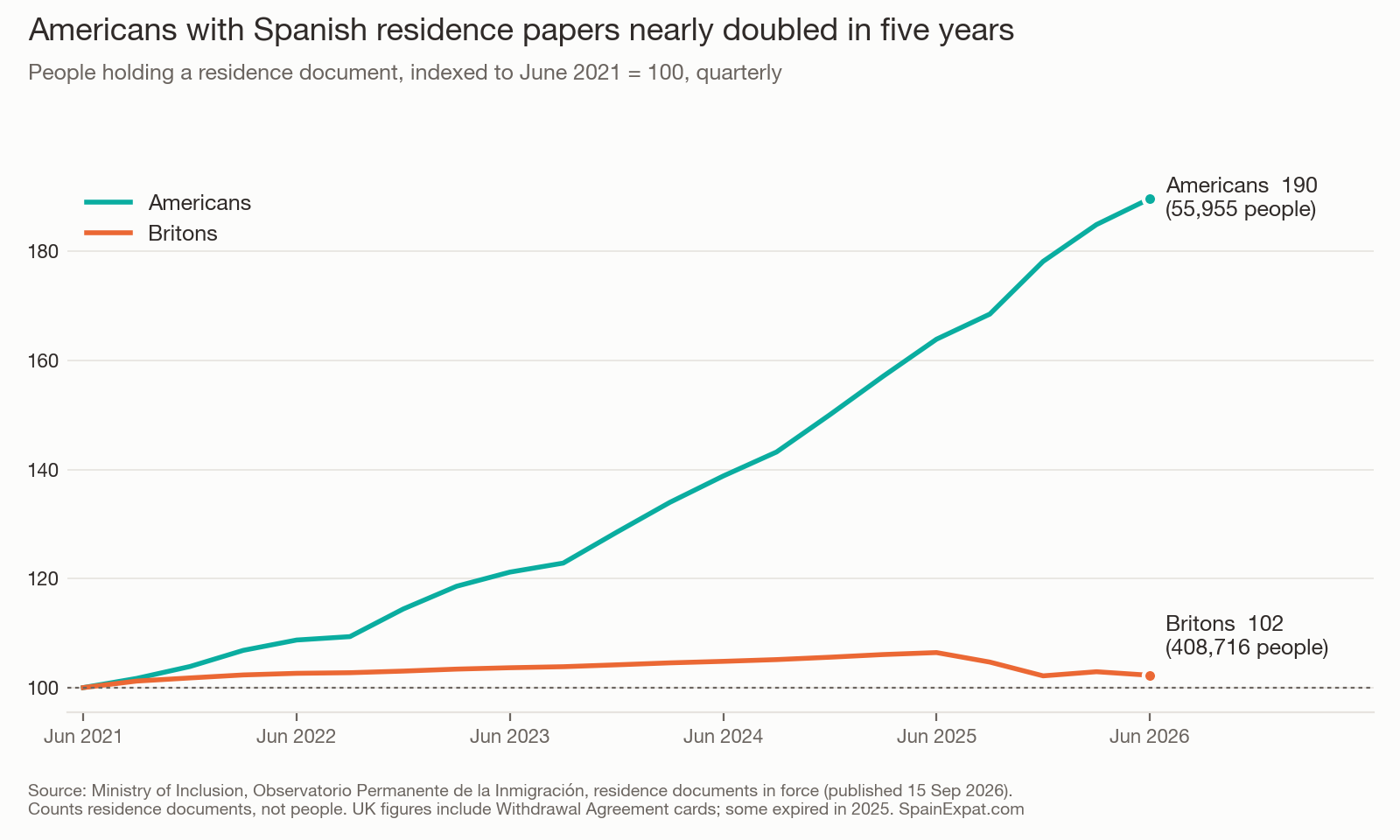
And the flow is still rising. Spain granted Americans 11,470 first-time residence documents in 2025, up 27.8%. Most of the growth runs through two visas: the Ley 14/2013 family, where Americans held 15,037 permits (up 3,799), and the non-lucrative visa for people living on savings or passive income, up 837 to 7,561. If you're an American weighing the move, those are the two to read up on first. Our digital nomad visa guide has the 2026 income threshold, our price comparison shows what lawyers and visa agencies charge to file it, and the non-lucrative visa guide for Americans goes consulate by consulate. Remote workers on the digital nomad visa can also opt into the Beckham law, Spain's special tax regime for newcomers, if they meet its conditions. You opt in on a tax form, Modelo 149, which has to be filed within six months of starting the work that qualifies you, so read up on it before you start here rather than after.
Unlike the British, Americans head for the cities. Madrid and Barcelona provinces hold 46% of them, and the ninth-biggest American town in Spain is Rota (there's a US naval base there, which explains a lot).
The British are the only one of the ten largest groups to shrink. The ministry counted 408,716 UK nationals with a residence document on 30 June 2026, 16,631 fewer than a year earlier (down 3.9%), which is the biggest fall in raw numbers of any nationality. The Colombians are now 13,257 behind them and gaining fast, though we won't put a date on the overtake.
Part of the fall is paperwork rather than people. The temporary Withdrawal Agreement cards Spain issued after Brexit were valid for five years, and they started expiring in 2025 (Withdrawal Agreement holders fell 5.5% in the year). Some holders moved on to permanent cards or ordinary permits, and others let theirs lapse because they'd already left or couldn't qualify, the ministry says. Either way, a lapsed card drops off the count the day it runs out, however long ago its owner went home to Stockport, so nobody can tell you from these tables how many Britons have left.
Britons on ordinary permits, mostly people who came after Brexit, rose 24% to 28,915. So the British are still coming, just on the same visas as everybody else now (and with the same paperwork, which has a certain poetry to it).
The British who stay, stay together. Alicante and Málaga provinces hold 41% of them, and in San Fulgencio nearly one resident in three is British. If your temporary card is coming up for renewal, one poster in an October 2025 r/GoingToSpain thread took form EX-23, the fee receipt, a recent padrón certificate (proof you're on the town hall's list of residents), their passport and the old card to the appointment.
Our view at SpainExpat is that Colombians and Venezuelans are doing more for everyday life in Spain than any other newcomers. Call it the barbershop economy (the haircut, the café con leche, the parcel at your door, the carer who sits with somebody's grandmother), and take a walk through a Madrid barrio to hear the accents behind the counters. They arrive speaking the language, so the only foreign thing about their move is the bureaucracy (which, to be fair, is foreign to everybody).
The work part we can back with numbers. Colombians and Venezuelans supplied 32% of the year's growth in foreign workers on the Social Security books. In September 2026, 387,371 Colombians were registered, up 53.1% in a year (many of them people the regularisation brought onto the books).
The barbershop is an analogy, to be clear. Colombians and Venezuelans mostly work on somebody else's payroll rather than behind their own till, and their self-employment rates (6.9% and 7.9%) are about half the foreign average of 15%. If you're looking for the people who own the shop, try the Chinese (52.1% self-employed, more than three times the foreign average), the Italians (20.1%) or the Romanians (16.4%). The Chinese are a settled community these days (four in five Chinese permit holders already have long-term residence), growing slowly (up 3.5% in a year), and the self-employed workers' association UPTA says their new businesses are moving on from the bazaars into bars, beauty salons and fashion.
And then there's the care. Social Security has a special scheme for people employed by households (cleaners, nannies, and the live-in carers who look after elderly people at home). Nearly half the people on it are foreign, 48.7% in September 2026, and Colombians are the biggest single group (28,599), ahead of Romanians and Peruvians. Somebody should tell the mayores.
Residence documents count papers rather than people, and the gap runs both ways. Undocumented residents don't show up at all, which is how 100,914 Colombians can "arrive" in a year most of them spent here. EU certificates never expire, so EU totals include people who left years ago. And Latin Americans can apply for Spanish nationality after two years of legal residence, at which point they vanish from the foreigner count and reappear as Spaniards, so their long-run totals look smaller than the real flow.
Growth also mixes new arrivals with regularisation, above all for Colombians, Peruvians, Hondurans and Paraguayans. The only survey that names groups is from 2020. And the ministry warns that its latest quarters may be revised, so a few of these figures may shift.
If you moved here in the past year, tell us in the comments which visa you came on and where you landed. SpainExpat also runs a paid service, Plus Ultra, for households moving to Spain.
On 30 June 2026, 55,955 US nationals held a Spanish residence document, the Ministry of Inclusion's Observatorio Permanente de la Inmigración reports. That was 15.7% more than a year earlier and 89.7% more than in June 2021.
The count covers papers in force, so Americans who have become Spanish citizens, or who live here without a residence document, are missing from it.
The Ministry of Inclusion counted 408,716 UK nationals holding a Spanish residence document on 30 June 2026, 3.9% fewer than a year earlier and the biggest fall in raw numbers of any nationality. Over five years the total is still up 2.3%.
Within it, UK nationals on ordinary permits, the kind most Britons moving here since 2021 have needed, rose 24% to 28,915.
Colombians grew most in raw numbers, with 100,914 more residence-document holders in the year to 30 June 2026 on Ministry of Inclusion figures. Among groups with at least 50,000 holders, Peruvians grew fastest in percentage terms (up 35.6%), just ahead of Colombians (up 34.3%).
Americans, up 15.7%, are the fastest-growing large group from a rich country.
Mostly because Colombians who were already living here got papers. More than half of the year's increase in Colombian ordinary permits (56,194) came through arraigo, the permit for people who can show they already live in Spain, while employee work permits fell by 12,430, Ministry of Inclusion figures to 30 June 2026 show.
Colombians also filed about 303,500 applications in the 2026 extraordinary regularisation, which barely shows in those figures yet.
Many of them aren't from Italy. Two in three Italians living in Spain at the end of 2023 were born outside Italy, according to ISTAT, Italy's statistics office, and many are Argentines and Venezuelans of Italian descent. Italian-born Italians are coming too, and in 2025 Spain was the top destination for Italians leaving Italy, at about 13,000.
About five-sixths of it. In the year to 30 June 2026, EU citizens added 91,408 residence documents and everyone else added 456,316 (83.3% of the increase), Ministry of Inclusion figures show. Latin Americans alone accounted for 48.5% of the total.
Spanish law has no expat category. Here the word means any foreign national holding a Spanish residence document, whether that's a non-EU permit, an EU registration certificate or a Withdrawal Agreement card. That's the Ministry of Inclusion's measure, and it counted 7,909,008 people on 30 June 2026.


SpainExpat.com has been online since 2000. This is currently the 5th major version of the site.
Crafted by this expat in Spain. See sister properties: Expatriator – AI for Immigration and Spanglish AI Classifieds for Puerto Rico
Site content protected by Aposema and available for x402 AI licensing.
The logo takes its colours from the sky over Madrid. Weather data: © AEMET, Spain’s Agencia Estatal de Meteorología, with MET Norway as backup.


Add a comment
Visit the old SpainExpat forum for community discussions.