Spain's public healthcare system ranked #1 globally by the World Economic Forum. Learn how to access it: getting your healthcare card, social security registration, and what coverage you're entitled to as an expat.
That said, you can occasionally "beat the system" with luck and persuasion.
Let's not bury the lead: Spain has the #1 ranked healthcare system in the world according to the World Economic Forum's 2019 Global Competitiveness Report.

Read the full competitiveness report for 2019 here
Health care in Spain is free and universal at the point of use for anyone plugged into the system, and it's mandated by the constitution to be provided by the government. According to the WHO's famous 2000 ranking (ancient now, but still the last of its kind), Spain's healthcare ranked 7th in the world for effectiveness, yet 24th in cost per person — lower on the spending table is better here, since it means Spain gets more for less. For comparison, the UK ranked 18th in effectiveness and 26th in cost per capita; the US healthcare system ranked 37th and 1st(!) respectively.
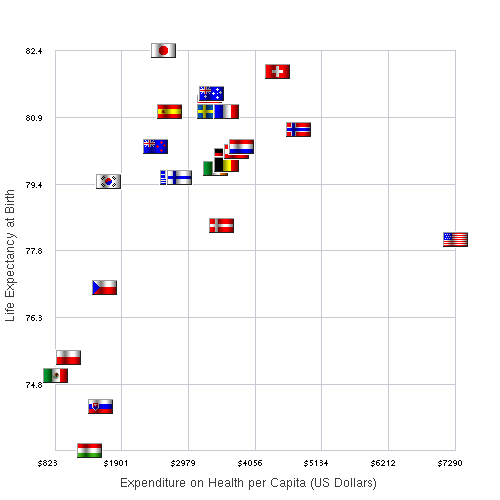 Expenditures on healthcare per capita compared to life expectancy at birth, from Wikipedia. No surprise, Spain does extremely well.
The cost effectiveness of Spain's healthcare system, measured in terms of life expectancy versus spending, is 2nd in the world behind Japan's.
The problem is that to become insured under the SNS (Sistema Nacional de Salud, Spain's public health system) you need a route in: a job, self-employment, a pension, or an administrative status that qualifies you. Which route applies depends on why you're in Spain and how you're supporting yourself.
To get a social security number, you generally have to either work for a company or register as self-employed (autónomo), in which case you'll pay a monthly quota to be part of the system. Once you're contributing, you and your dependents (spouse, children) are covered on the same basis as any Spanish worker. That said, you can occasionally "beat the system" with luck and persuasion — an American friend of ours arrived in Spain at 76 years old and managed to convince the people at the social security office to give her a number.
If your country of origin has universal health care and pays for exportable coverage, you may be able to get your country to fund your healthcare in Spain instead of paying in yourself. For UK state pensioners this works through the S1 form (which replaced the old E121/E106): once you're claiming a UK State Pension, request an S1 from NHS Overseas Healthcare Services and register it with the INSS (Instituto Nacional de la Seguridad Social) here. Once registered, you and your dependents use the SNS on the same footing as a Spanish citizen, with no monthly quota, because the UK foots the bill. Other EU/EEA countries have equivalent arrangements. One quirk worth knowing: a dependent covered under someone else's S1 loses that cover the moment they start claiming their own state pension; they then need to register their own S1 to avoid a gap.
This is the route most non-working expats end up using. The convenio especial (special agreement) lets you buy into the SNS directly, with no job and no pension behind you. As of 2026, the requirements are:
The nationally set price: €60/month if you're under 65, or €157/month if you're 65 or older. That buys the core public services with no copays: primary care, specialists, hospitalization, emergency transport, outpatient and inpatient alike. You do pay 100% out of pocket for outpatient prescriptions, orthopedic supplies, dietary products, and non-urgent transport, which sit outside the agreement. Signup runs through your regional health service; each autonomous community (Andalucía, Cataluña, Comunidad Valenciana, etc.) handles its own process.
The catch is the one-year residency clock. If you've been in Spain less than a year and don't qualify through work, self-employment, or a pension, you'll need private health insurance for that first year, which is mandatory anyway on certain visas (more on that below).
The two systems solve different problems. Public healthcare (SNS) is comprehensive, and the care itself, especially for anything serious, is excellent. The weak spot is waiting times: lists for specialists and non-emergency surgery can run weeks to months depending on the region and specialty. Dental care is minimal under the public system (mostly emergency extractions), so almost everyone in Spain, Spanish nationals included, uses a private dentist.
Private health insurance (Sanitas, Adeslas, ASISA and the like) is cheap by US or UK standards and buys you exactly that speed: same-week specialist appointments, private hospital rooms, and a wider choice of doctor. Plenty of long-term expats carry private cover even after they're enrolled in the public system — private for the routine stuff, SNS for anything serious or expensive.
If you're applying for certain Spanish residency visas, private health insurance is a hard document requirement, and the bar is specific. Both the Non-Lucrative Visa (NLV) and the Digital Nomad Visa (officially the "visado de teletrabajo," or telework visa) require proof of health insurance that:
An insurance card by itself won't satisfy the requirement either; you need the actual policy documentation showing the coverage terms, and the fine print varies a little by consulate, so check your own consulate's checklist. One difference between the two visas: Digital Nomad applicants already enrolled in Spanish Social Security (through an employer or as autónomo via RETA) generally don't need to separately prove private insurance, since Social Security coverage satisfies the requirement. NLV applicants aren't allowed to work, so for them private insurance is the only way to meet it.
If you're weighing insurers for a visa application or ongoing cover, our Health Insurance in Spain guide covers pricing by age, pre-existing conditions, and what changes once you're a policyholder rather than an applicant.
If you're in Spain temporarily and you're from the UK or EU/EEA, your EHIC (European Health Insurance Card), or its UK replacement the GHIC, gets you medically necessary public healthcare during your stay: A&E visits, flare-ups of pre-existing conditions, that kind of thing. It's free to get and worth carrying. It won't cover medical repatriation, treatment at private clinics, or things like mountain rescue, so bring separate travel insurance for the rest.
You need a healthcare card, the TSI (Tarjeta Sanitaria Individual), in order to access non-emergency healthcare in Spain. If you're not registered (empadronado), you can only access emergency healthcare centres in the event of an accident or serious illness.
In order to obtain your healthcare card, you need to be registered and join the Social Security system, even if you're in Spain in an irregular administrative situation (i.e., overstayed visa and/or haven't empadronado yet).
These are the steps to obtain your healthcare card:
In practice the whole sequence takes anywhere from a few days to several weeks depending on the region and how busy the local offices are — Madrid and Barcelona tend to run slower than smaller towns. The stamped document covers doctor visits and prescriptions in the meantime, so don't wait on the plastic card to see someone.
For questions, try the Spain Expat Facebook page or comment below (you'll need to be signed in). Once the public side is sorted, see Doctors in Spain for finding and switching doctors, and our banking guide for the Spanish bank account you'll likely need to pay the convenio especial or an insurer by direct debit.
SpainExpat Plus Ultra
Plus Ultra is SpainExpat's household membership. We pay the professionals who do the work, and the Compliance Minder tracks the deadlines that come with living in Spain.
Ask for an invitation You'll see your price and terms before you pay anything.You do not need to be a legal resident or have economic means to access healthcare.
You need a healthcare card in order to access healthcare in Spain. However, if you are not registered (empadronado) you can only access emergency healthcare centres in the event of an accident or a serious illness.
In order to obtain your healthcare card, you need to be registered and join the Social Security system, even if you are in Spain in an irregular administrative situation (i.e. overstayed visa and/or have not empadronado).
These are the steps to obtain your healthcare card:
Visit the old SpainExpat forum for community discussions.


SpainExpat.com has been online since 2000. This is currently the 5th major version of the site.
Crafted by this expat in Spain. See sister properties: Expatriator – AI for Immigration and Spanglish AI Classifieds for Puerto Rico
Site content protected by Aposema and available for x402 AI licensing.
The logo takes its colours from the sky over Madrid. Weather data: © AEMET, Spain’s Agencia Estatal de Meteorología, with MET Norway as backup.


